
Technical Data Sheet Cu-ETP
Cu-ETP
Standards/Alloys: STANDARD: EN 13601 / Cu-ETP; CW004A
Cu-ETP, Copper bars (busbars)
Cu-ETP is an electrolytically refined copper with oxygen content. It has very good electrical conductivity and is an economically advantageous option compared to other copper alloys with high conductivity. Due to the residual oxygen content, this type of copper is not suitable for welding, being susceptible to hydrogen embrittlement.
Typical fields of application include power distribution systems (busbars) and switchgear construction (low and medium voltage).
Composition
| CU [%] | O [%] | BI [%] | PB [%] |
| min 99.90 | max 0.04 | max 0.0005 | max 0.005 |
Physical Properties
The composition of this alloy complies with the RoHS directives for electrical and electronic components, as well as ELV regulations for the automotive industry.
| MELTING POINT [°C] | DENSITY [G/CM3] | SPECIFIC THERMAL CAPACITY [J/G*K] | YOUNG'S MODULUS [GPA] | THERMAL CONDUCTIVITY [W/MK] | ELECTRICAL CONDUCTIVITY [MS/M] | ELECTRICAL CONDUCTIVITY [%IACS] | COEFFICIENT OF THERMAL EXPANSION [10-6/K] |
| 1083 | 8.92 | 0.394 | 130 | 394 | > 58 | >100 | 17.7 |
Note: The specified conductivity applies only in the soft condition.
Processing Properties
| Cold deformation (bending) | excellent |
| Hot tinning properties | excellent |
| Electroplating properties | excellent |
| Hot deformation | excellent |
| Soft soldering, brazing | excellent |
| Oxyacetylene welding | less suitable |
| Gas-shielded arc welding | less suitable |
| Resistance welding | less suitable |
| Machinability | less suitable |
Electrical Conductivity
Electrical conductivity depends on the chemical composition, the degree of cold deformation, and the grain size. A high degree of deformation as well as a small grain size reduce conductivity.
Corrosion Resistance
Copper is resistant to: natural and industrial atmospheres, marine air, drinking and process water, non-oxidizing acids, alkaline solutions, and neutral saline solutions.
Copper is not resistant to: solutions and atmospheres containing ammonia, halogens, cyanides and hydrogen sulfides, oxidizing acids, and seawater (especially at high flow rates).
Due to the oxygen content, Cu-ETP is not resistant to hydrogen embrittlement in reducing atmospheres at high temperatures.
Typical Applications
– Switchgear construction (low and medium voltage)
– Power distribution systems (busbars)
– Transformers / electrical components
– Electric machine construction
– Wind energy
– Automotive industry
Mechanical Properties
| MATERIAL CONDITION | DIMENSIONS IN MM | |||||||
| THICKNESS MM | WIDTH MM | HARDNESS VICKERS HV MIN. | HARDNESS VICKERS HV MAX. | TENSILE STRENGTH Rm N/MM² MIN. | YIELD STRENGTH 0.2% Rp0,2 N/MM² | ELONGATION A100 MM % MIN. | ELONGATION A % MIN. | |
| D | 0.5–40 | 1–200 | Cold worked, no specific mechanical properties | |||||
| H035a | 0.5–40 | 1–200 | 35 | 65 | — | — | — | — |
| R200a | 1–40 | 5–200 | — | — | 200 | max. 120 | 25 | 35 |
| H065 | 0.5–40 | 1–200 | 70 | 95 | — | — | — | — |
| R250 | 1–10 | 5–200 | — | — | 250 | min. 200 | 8 | 12 |
| R250 | 10–40 | 10–200 | — | — | 250 | min. 180 | — | 15 |
| R230 | 10–40 | 10–200 | — | — | 230 | min. 160 | — | 18 |
| H085 | 0.5–20 | 1–120 | 90 | 115 | — | — | — | — |
| H075 | 20–40 | 20–160 | 80 | 105 | — | — | — | — |
| R300 | 1–10 | 5–120 | — | — | 300 | min. 260 | 5 | 8 |
| R280 | 10–20 | 10–160 | — | — | 280 | min. 240 | — | 10 |
| R260 | 20–40 | 20–160 | — | — | 260 | min. 220 | — | 12 |
| H100 | 0.5–5 | 1–120 | 110 | — | — | — | — | — |
| R350 | 1–5 | 5–120 | — | — | 350 | min. 320 | 3 | 5 |
Tolerances for Width and Thickness of Rectangular Bars
Dimensions in millimetres
| NOMINAL WIDTH | THICKNESS TOLERANCE FOR NOMINAL THICKNESS RANGES | WIDTH TOLERANCE | ||||||
| FROM | UP TO AND INCLUDING | 0.5 to 3 | 3 to 6 | 6 to 10 | 10 to 18 | 18 to 30 | 30 to 40 | |
| 1 | 10 | ±0.08 | ±0.05 | ±0.06 | ±0.08 | — | — | — |
| 10 | 18 | ±0.10 | ±0.05 | ±0.06 | ±0.08 | ±0.10 | — | — |
| 18 | 30 | ±0.15 | ±0.05 | ±0.07 | ±0.09 | ±0.10 | ±0.15 | — |
| 30 | 50 | ±0.20 | ±0.06 | ±0.09 | ±0.10 | ±0.12 | ±0.15 | ±0.20 |
| 50 | 80 | ±0.25 | ±0.09 | ±0.10 | ±0.12 | ±0.15 | ±0.18 | ±0.25 |
| 80 | 120 | ±0.30 | — | ±0.12 | ±0.15 | ±0.18 | ±0.23 | ±0.30 |
| 120 | 160 | ±0.40 | — | — | ±0.18 | ±0.20 | ±0.25 | ±0.35 |
| 160 | 200 | ±0.50 | — | — | ±0.20 | ±0.25 | ±0.30 | ±0.40 |
This leaflet is strictly for informational purposes and is not subject to revisions. No claims can be made based on it, unless there is evidence of intent or gross negligence. The data presented does not constitute a guarantee of specific product quality and cannot replace specialist advice or the customer's own tests.
Tolerances for "As-Manufactured" Length
Values in millimetres
| NOMINAL LENGTH | NOMINAL DIAMETER OR WIDTH | LENGTH TOLERANCE |
| 3000, 3500, 4000, 4500, 5000, 5500, 6000 | 2–50 | ±200 |
| 50–120 | ±300 | |
| By agreement | 120–200 | ±500 |
Corner configuration: rectangular bars can be supplied with square corners, rounded corners, or semi-circular edges.
The corner type must be specified at the time of ordering: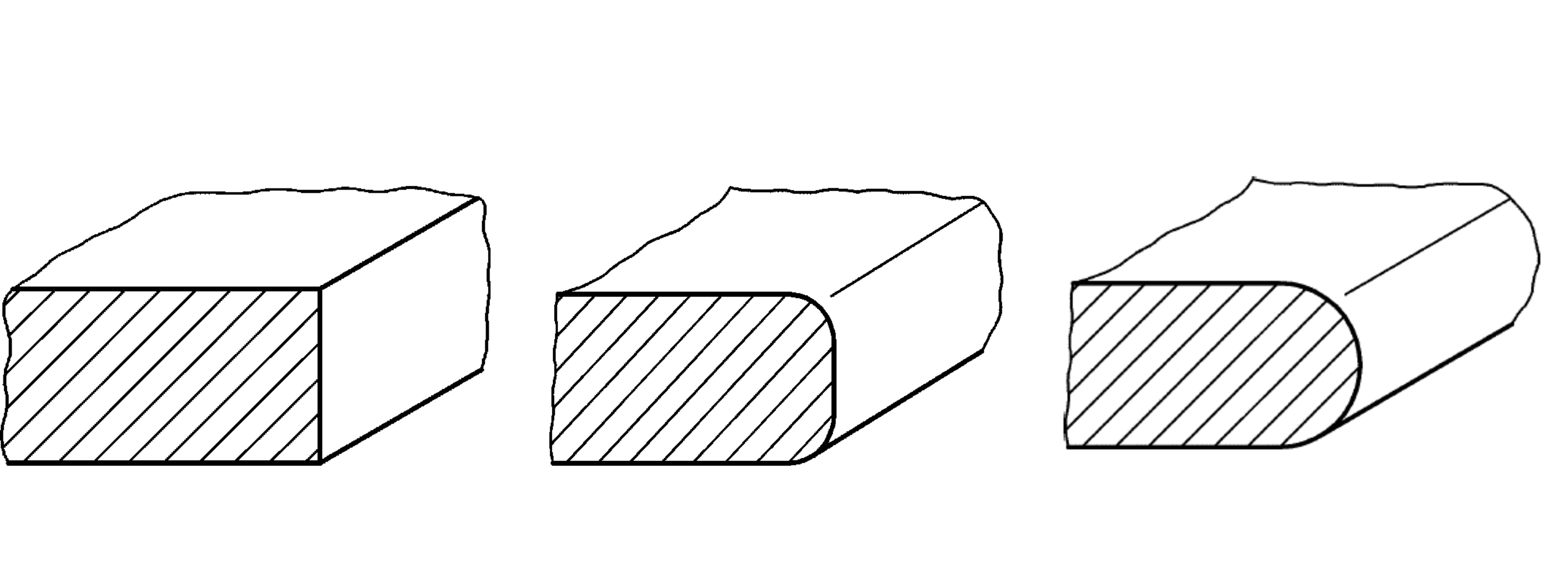
a) Square corners (SH) b) Rounded corners (RD) c) Semi-circular edges (CE)
Corner Radii for Rounded-Corner Bars
| NOMINAL THICKNESS | CORNER RADIUS | CORNER RADIUS TOLERANCE | |
| FROM | UP TO AND INCLUDING | ||
| 0.5 | 1 | — | — |
| 1 | 3 | 0.5 | — |
| 3 | 6 | 0.8 | ±0.2 |
| 6 | 10 | 1.0 | ±0.3 |
| 10 | 30 | 1.6 | ±0.4 |
| 30 | 80 | 2.5 | ±0.5 |
| 80 | 120 | 4.0 | ±1.0 |
| 120 | 160 | 6.0 | ±1.0 |